Validation of Regressor Implementations
This is an example script which replicates published results for the MC-dropout, Deep Ensemble, and Split Conformal Quantile Regression (CQR) methods. Additionally, average coverage is validated for the K-fold-CQR and normalized conformal ensemble methods. This script matches the experimental setup described in each of these papers using public datasets, runs one fit-predict trial, and verifies that the desired results land within the probable range reported in the published results.
Utility functions for running regressor tests:
import numpy as np
import torch
from uqregressors.utils.torch_sklearn_utils import train_test_split
from uqregressors.tuning.tuning import tune_hyperparams, log_likelihood
from uqregressors.utils.logging import set_logging_config
from uqregressors.utils.file_manager import FileManager
from uqregressors.bayesian.dropout import MCDropoutRegressor
from uqregressors.bayesian.deep_ens import DeepEnsembleRegressor
from uqregressors.utils.data_loader import clean_dataset, validate_dataset
from uqregressors.metrics.metrics import compute_all_metrics
from uqregressors.utils.data_loader import load_unformatted_dataset
from uqregressors.conformal.cqr import ConformalQuantileRegressor
from uqregressors.conformal.k_fold_cqr import KFoldCQR
from uqregressors.conformal.conformal_ens import ConformalEnsRegressor
from pathlib import Path
from copy import deepcopy
import optuna
device = "cuda" if torch.cuda.is_available() else "cpu"

r_seed = 42
set_logging_config(print=False) # Disable logging for all future regressors for cleanliness
optuna.logging.set_verbosity(optuna.logging.WARNING) # Disable hyperparameter logging for cleanliness

def test_regressor(model, X, y, dataset_name, test_size, seed=None,
                   tuning_epochs=None, param_space=None, scoring_fn=None, greater=None,
                   initial_params=None, n_trials=None, n_splits=1):
    if seed is not None:
        np.random.seed(seed)
        torch.manual_seed(seed)

    X, y = clean_dataset(X, y)
    validate_dataset(X, y, name=dataset_name)

    X_train, X_test, y_train, y_test = train_test_split(X, y, test_size=test_size, random_state=seed)

    # Hyperparameter Optimization:
    if tuning_epochs is not None and param_space is not None:
        epochs_copy = model.epochs
        model.epochs = deepcopy(tuning_epochs)
        opt_model, opt_score, study = tune_hyperparams(regressor=model,
                                                        param_space=param_space,
                                                        X=X_train,
                                                        y=y_train,
                                                        score_fn=scoring_fn,
                                                        greater_is_better=greater,
                                                        initial_params=initial_params,
                                                        n_trials=n_trials,
                                                        n_splits=n_splits,
                                                        verbose=False
                                                        )
        model = opt_model
        model.epochs = epochs_copy

    # Modify learning rate for deep ensembles on energy and kin8nm datasets:
    if type(model) is DeepEnsembleRegressor:
        print (type(model))
        if dataset_name in ["energy", "kin8nm"]:
            print("Setting learning rate to 1e-2")
            model.learning_rate = 1e-2

        else:
            print ("Setting learning rate to 1e-1")
            model.learning_rate =1e-1

    model.fit(X_train, y_train)
    mean, lower, upper = model.predict(X_test)

    metrics = compute_all_metrics(mean, lower, upper, y_test, model.alpha)
    metrics["scale_factor"] = np.mean(np.abs(y)).astype(np.float64)

    return metrics

def run_regressor_test(model, datasets, seed, filename, test_size,
                       BASE_SAVE_DIR=Path.home()/".uqregressors",
                       tuning_epochs=None, param_space=None, scoring_fn=None, greater=None,
                       initial_params=None, n_trials=None, n_splits=1):
    DATASET_PATH = Path.cwd().absolute() / "datasets"
    saved_results = []
    for name, file in datasets.items():
        print(f"\n Loading dataset: {name}")
        X, y = load_unformatted_dataset(DATASET_PATH / file)

        metrics = test_regressor(model, X, y, name, seed=seed, test_size=test_size,
                                 tuning_epochs=tuning_epochs, param_space=param_space,
                                 scoring_fn=scoring_fn, greater=greater, initial_params=initial_params,
                                 n_trials=n_trials, n_splits=n_splits)
        print(metrics)

        fm = FileManager(BASE_SAVE_DIR)
        save_path = fm.save_model(model, name=name + "_" + filename, metrics=metrics)
        saved_results.append((model.__class__, name, save_path))
    return saved_results

def print_results(paths):
    fm = FileManager()
    for cls, dataset_name, path in paths:
        results = fm.load_model(cls, path=path, load_logs=False)
        print (f"Results for {dataset_name}")
        print(results["metrics"])
Datasets
A variety of datasets are chosen which match the datasets for which there are published results. Extremely large datasets, and those where there is ambiguity about which target is being predicted are omitted.
Information about the datasets used is available in: Hernández Lobato and Adams, 2015.
datasets_bayesian = {
    "concrete": "concrete.xls",
    "energy": "energy_efficiency.xlsx",
    "kin8nm": "kin8nm.arff",
    "power": "power_plant.xlsx",
    "wine": "winequality-red.csv",
}

datasets_conformal = {
    "concrete": "concrete.xls"
}
import matplotlib.pyplot as plt
import numpy as np

def plot_validation(pub, save_paths, name, metric_1, metric_2, metric_1_name, metric_2_name):
    save_paths_dict = dict(zip([path[1] for path in save_paths], [(path[0], path[2]) for path in save_paths]))

    MCD_exp = {}
    fm = FileManager()
    for key, (RMSE, RMSE_std, LL, LL_std) in pub.items():
        MCD_exp[key] = fm.load_model(model_class=save_paths_dict[key][0], path=save_paths_dict[key][1])["metrics"]

    datasets = list(pub.keys())
    datasets.reverse()
    y_pos = np.arange(len(datasets))

    # Prepare RMSE and LL values
    pub_rmse = np.array([pub[d][0] for d in datasets])
    pub_rmse_err = np.array([1.96 * pub[d][1] for d in datasets])
    exp_rmse = np.array([MCD_exp[d][metric_1] for d in datasets])

    pub_ll = np.array([pub[d][2] for d in datasets])
    pub_ll_err = np.array([1.96 * pub[d][3] for d in datasets])
    if metric_2 is "nll_gaussian":
        exp_ll = np.array([-MCD_exp[d][metric_2] for d in datasets])
    else:
        exp_ll = np.array([MCD_exp[d][metric_2] for d in datasets])

    # Plot RMSE
    fig, ax = plt.subplots(figsize=(8, 5))
    ax.errorbar(pub_rmse, y_pos, xerr=pub_rmse_err, fmt='o', label='Published (95% CI)', color='blue', capsize=6)
    ax.scatter(exp_rmse, y_pos, color='red', label='Experimental', zorder=5)
    ax.set_yticks(y_pos)
    ax.set_yticklabels(datasets)
    ax.set_xlabel(metric_1_name)
    ax.set_title(f"{name}: {metric_1_name} Validation")
    ax.legend()
    ax.grid(True)

    # Plot Log Likelihood
    fig2, ax2 = plt.subplots(figsize=(8, 5))
    ax2.errorbar(pub_ll, y_pos, xerr=pub_ll_err, fmt='o', label='Published (95% CI)', color='blue', capsize=6)
    ax2.scatter(exp_ll, y_pos, color='red', label='Experimental', zorder=5)
    ax2.set_yticks(y_pos)
    ax2.set_yticklabels(datasets)
    ax2.set_xlabel(metric_2_name)
    ax2.set_title(f"{name}: {metric_2_name} Validation")
    ax2.legend()
    ax2.grid(True)

    plt.tight_layout()
    plt.show()
MC dropout Regressor
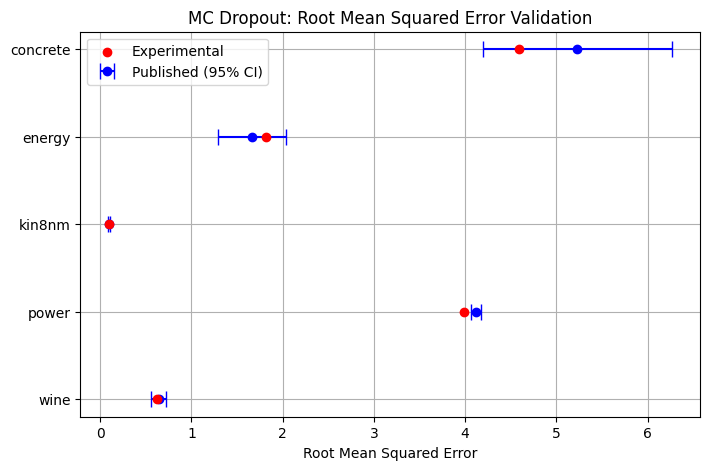
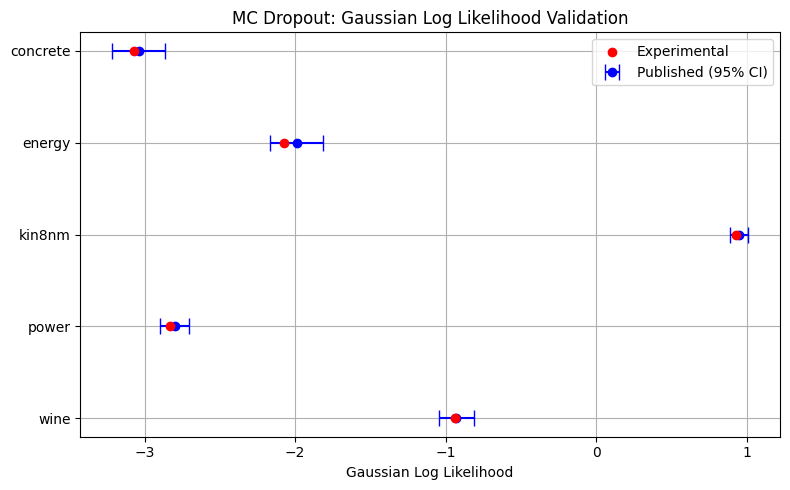
First, results are generated and compared to the results published in Gal and Ghahramani, 2016. As described in the paper, a single layer neural network with 50 hidden units is used with 0.05 dropout probability, and parameters optimized for 400 epochs with minibatch sizes of 32 on the Adam optimizer. Before training, the aleatoric uncertainty parameter, \(\tau\), is estimated with 30 iterations of Bayesian Optimization with initial prior length scale 0.01.
from uqregressors.tuning.tuning import log_likelihood, interval_score


dropout = MCDropoutRegressor(
    hidden_sizes = [50],
    dropout=0.05,
    use_paper_weight_decay=True,
    prior_length_scale=1e-2,
    alpha=0.05,
    n_samples=100,
    epochs=400, # Changed to 40 during hyperparameter tuning
    batch_size=32,
    learning_rate=1e-3,
    device=device,
    use_wandb=False
)

# Hyperparameter Tuning:
param_space = {
    "tau": lambda trial: trial.suggest_float("tau", 1e-2, 1e2, log=True)
}

MC_save_paths = run_regressor_test(dropout, datasets_bayesian, seed=r_seed, filename="dropout_validation", test_size=0.2,
                   tuning_epochs=40, param_space=param_space, scoring_fn=log_likelihood, greater=True, n_trials=40)

print_results(MC_save_paths)
MCD_pub = {
    "concrete": [5.23, 0.53, -3.04, 0.09],
    "energy": [1.66, 0.19, -1.99, 0.09],
    "kin8nm": [0.1, 0.005, 0.95, 0.03],
    "power": [4.12, 0.03, -2.80, 0.05],
    "wine": [0.64, 0.04, -0.93, 0.06]
}
plot_validation(MCD_pub, MC_save_paths, "MC Dropout", "rmse", "nll_gaussian", "Root Mean Squared Error", "Gaussian Log Likelihood")
Deep Ensemble Regressor
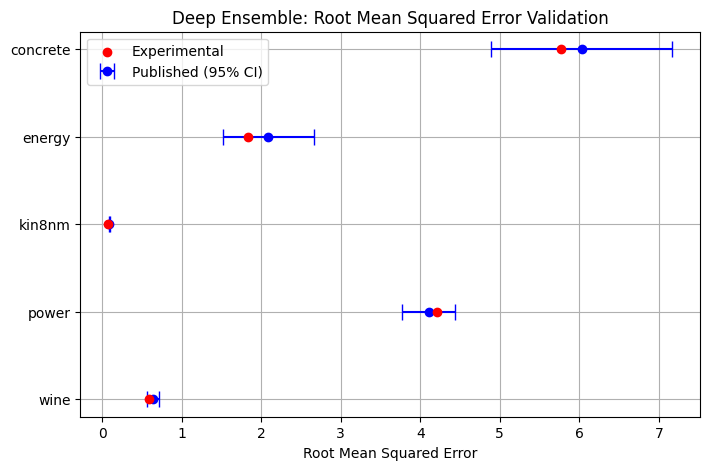
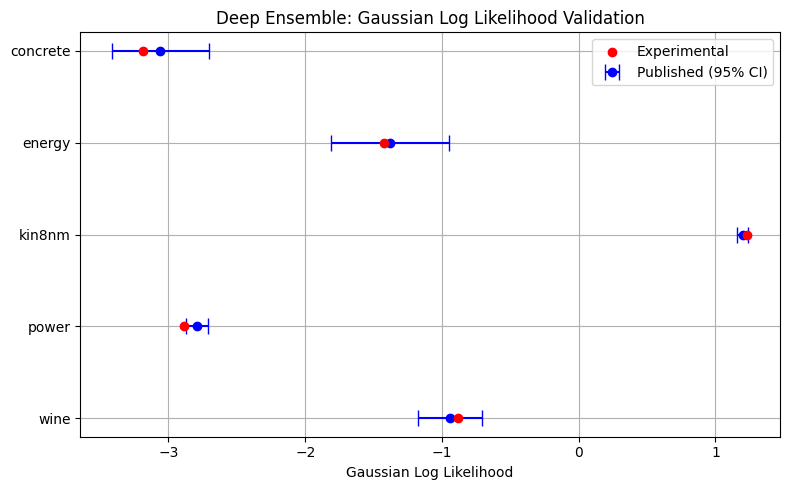
Next, validation is performed for the Deep Ensemble Regressor as in Lakshminarayanan et. al. 2017. A very similar experimental setup as that of MC Dropout is carried out using a Deep Ensemble with 5 estimators, each a single layer neural network with 50 hidden units, a batch size of 100, and a learning rate of either 1e-1 or 1e-2 on the Adam optimizer.
deep_ens = DeepEnsembleRegressor(
    n_estimators=5,
    hidden_sizes=[50],
    n_jobs=2,
    alpha=0.05,
    batch_size=100,
    learning_rate=1e-1, #Changed to 1e-2 for energy and kin8nm datasets
    epochs=40,
    device=device,
    scale_data=True,
    use_wandb=False
)

deep_ens_save_paths = run_regressor_test(deep_ens, datasets_bayesian, seed=r_seed, filename="deep_ens_validation", test_size=0.1)
DE_pub = {
    "concrete": [6.03, 0.58, -3.06, 0.18],
    "energy": [2.09, 0.29, -1.38, 0.22],
    "kin8nm": [0.09, 0.005, 1.2, 0.02],
    "power": [4.11, 0.17, -2.79, 0.04],
    "wine": [0.64, 0.04, -0.94, 0.12]
}
plot_validation(DE_pub, deep_ens_save_paths, "Deep Ensemble", "rmse", "nll_gaussian", "Root Mean Squared Error", "Gaussian Log Likelihood")
Split Conformal Prediction
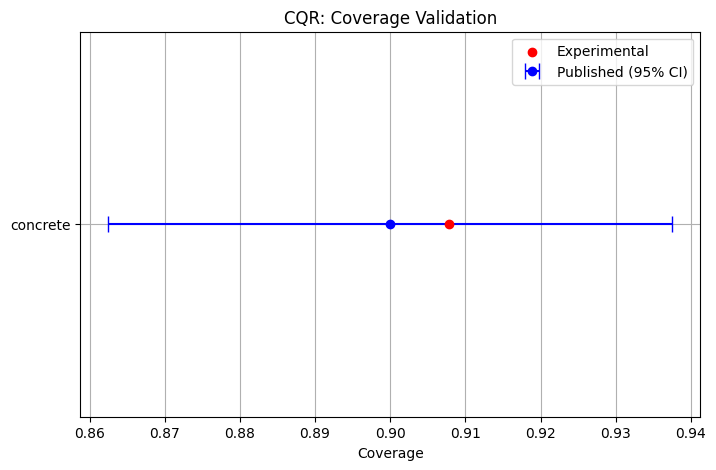
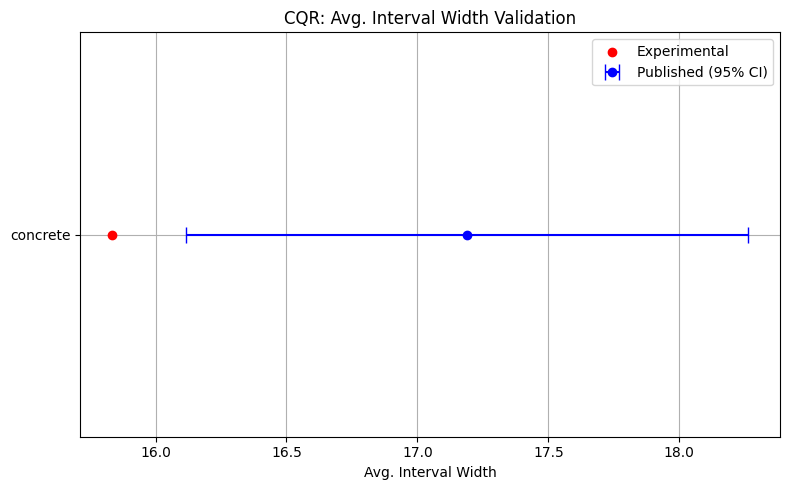
Next, split conformal prediction is validated according to the results in Romano et. al. 2019. A split conformal quantile regressor with half of the training data in the calibration set, two hidden layers of 64 neurons each, a 0.1 dropout probability, and trained for 1000 epochs with a batch size of 64 using the standard quantile loss function is implemented as in the paper, and compared to the published results on the concrete compressive strength dataset. Note that a mean and standard deviation for the published results were estimated from the reported box and whisker plot, and scaled by the mean of the outputs. A slightly better average interval width than published was found, likely due to small differences in the training procedure and hyperparameter tunining functions.
from uqregressors.tuning.tuning import interval_width
device = "cuda"

cqr = ConformalQuantileRegressor(
    hidden_sizes=[64, 64],
    cal_size = 0.5,
    alpha=0.1,
    dropout=0.1,
    epochs=1000,
    batch_size=64,
    learning_rate=5e-4,
    optimizer_kwargs = {"weight_decay": 1e-6},
    device=device,
    scale_data=True,
    use_wandb=False
)

param_space = {
    "tau_lo": lambda trial: trial.suggest_float("tau_lo", 0.03, 0.1),
}

cqr_save_paths = run_regressor_test(cqr, datasets_conformal, seed=r_seed, filename="cqr_validation", test_size=0.2,
                                    tuning_epochs=1000, param_space=param_space, scoring_fn=interval_width, greater=False,
                                    n_trials=15, n_splits=3)
conformal_pub = {
    "concrete": [0.9, 0.01913, 17.189, 0.5479]
}
plot_validation(conformal_pub, cqr_save_paths, "CQR", "coverage", "average_interval_width", "Coverage", "Avg. Interval Width")